
Most people first met AI as a chatbot: you ask a question, it gives an answer, and you decide what to do next. Agentic AI goes a step further. Instead of only answering, an AI agent is given a goal and works towards it on its own: it plans the steps, uses tools such as search, databases, email or code, checks the results, and keeps going until the job is done or it needs a human decision.
This guide explains what agentic AI is in simple terms, how AI agents work, how agentic AI differs from generative AI, where it is already being used, the main tools and frameworks for building agents, practical projects you can build to learn, and the latest research on where the technology is heading, including its risks.
Key takeaways
- Agentic AI refers to AI systems that pursue goals by planning, taking actions with tools and adjusting based on results, with limited human supervision.
- Generative AI creates content when asked; agentic AI uses generative models as a “brain” to decide and act across several steps.
- Gartner predicts 33% of enterprise software applications will include agentic AI by 2028, but also that over 40% of agentic AI projects will be cancelled by the end of 2027.
- The best way to learn is to build small, well-scoped agents with clear tools, human approval for risky actions and careful testing.
Table of contents
- What is agentic AI? (in simple words)
- How agentic AI works
- Agentic AI vs generative AI vs AI agents
- Agentic AI statistics: what the research says
- Agentic AI examples in real life
- Agentic AI tools and frameworks
- Build your first AI agent in Python
- 8 practical agentic AI projects
- Risks, limits and best practices
- How to learn agentic AI
- Frequently asked questions
What is agentic AI? (in simple words)
Agentic AI is artificial intelligence that can act with a degree of independence to achieve a goal. The word “agentic” comes from agency, the ability to act. An agentic AI system receives an objective, such as “find three suppliers for this part and draft an email to each”, then works out the steps, carries them out using software tools, and adapts if something goes wrong.
A useful comparison is the difference between a reference book and a capable intern. A chatbot is like the book: it answers what you ask. An agent is like the intern: you give it a task, it figures out what to do, uses the computer and the company’s systems, reports back, and asks you before doing anything important. Today’s agents are far from perfect interns, but that is the direction of travel.
Agentic AI is built on large language models, the same technology behind generative AI. If you want to understand where LLMs fit in the wider AI landscape, read our guide to AI vs machine learning vs deep learning.
How agentic AI works
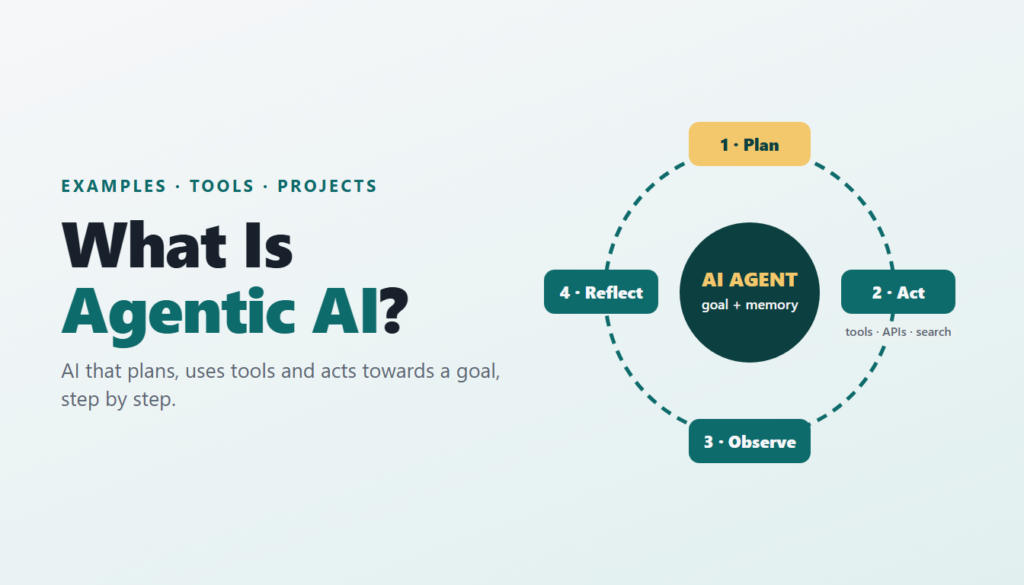
At the heart of every AI agent is a loop:
- Plan: the agent reads the goal and decides the next step.
- Act: it calls a tool, such as a web search, a database query, a calculator, an email API or a code runner.
- Observe: it reads the tool’s result.
- Reflect: it decides whether the goal is met, whether something went wrong, and what to do next. Then the loop repeats.
To run this loop, an agent combines several components:
- The model (the brain): a large language model that understands the goal, reasons about steps and chooses tools.
- Tools: functions the agent is allowed to call. Each tool has a name and a description, and the model decides when to use it. Tools are what turn a chatbot into an agent.
- Memory: short-term memory of the current task and, sometimes, long-term memory of past interactions or user preferences.
- Knowledge: access to documents and data, often through retrieval-augmented generation. Our tutorial on building a RAG chatbot with Python and LangChain shows how this works.
- Guardrails and human approval: rules that limit what the agent can do, and checkpoints where a person must approve risky actions such as sending money or emailing customers.
Some systems use several specialised agents that work together, for example a researcher agent, a writer agent and a reviewer agent. This is called a multi-agent system. It can handle more complex work, but it is also harder to test and control.
Agentic AI vs generative AI vs AI agents
These terms are often mixed up. Here is how they relate, along with predictive AI for comparison:
| Aspect | Predictive AI | Generative AI | Agentic AI |
|---|---|---|---|
| Main job | Predict or classify | Create content | Achieve goals by taking actions |
| Typical output | A score or label, such as “likely to churn” | Text, images, code or audio | Completed tasks: bookings, reports, updated records |
| How it works | Single prediction per input | Single response per prompt | Multi-step loop of planning, tool use and checking |
| Human role | Acts on the prediction | Prompts and edits the output | Sets the goal, approves key steps, reviews results |
| Example | Fraud detection model | Writing a product description | Researching competitors and preparing a summary report |
AI agents vs agentic AI: an AI agent is a single system that uses tools to complete tasks. Agentic AI is the broader approach or field: designing AI systems, sometimes with many agents, that operate with goal-directed autonomy. In everyday use the terms overlap heavily, and you will often see them used interchangeably.
Agentic AI statistics: what the research says
Agentic AI is growing fast, but the research also points to plenty of hype. Both sides matter if you are learning or investing in it:
| Statistic | Source |
|---|---|
| 33% of enterprise software applications will include agentic AI by 2028, up from less than 1% in 2024 | Gartner, June 2025 |
| At least 15% of day-to-day work decisions will be made autonomously through agentic AI by 2028, up from 0% in 2024 | Gartner, June 2025 |
| Over 40% of agentic AI projects will be cancelled by the end of 2027, due to escalating costs, unclear business value or inadequate risk controls | Gartner, June 2025 |
| In a January 2025 poll of 3,412 webinar attendees, 19% said their organisation had made significant investments in agentic AI and 42% conservative investments | Gartner, June 2025 |
| Gartner estimates only about 130 of the thousands of agentic AI vendors are real, warning of “agent washing” of existing chatbots and automation tools | Gartner, June 2025 |
| 78% of organisations reported using AI in 2024, up from 55% the year before | Stanford HAI, AI Index Report 2025 |
| The cost of running a model performing at GPT-3.5 level dropped over 280-fold between November 2022 and October 2024 | Stanford HAI, AI Index Report 2025 |
| GitHub reported growing developer interest in AI agents, alongside a 98% increase in the number of generative AI projects in 2024 | GitHub Octoverse 2024 |
The message is balanced: agentic AI is moving into mainstream software, and falling model costs make multi-step agents affordable, but many early projects fail because they chase hype rather than a clear, measurable problem. People who can build agents that are reliable, safe and genuinely useful will be in demand.
Agentic AI examples in real life
- Customer support: an agent reads a customer’s message, looks up their order, checks the refund policy, processes a simple refund within set limits, and hands complex cases to a human with a summary.
- Software development: coding agents read a bug report, explore the codebase, write a fix, run the tests and propose the change for a developer to review.
- Research and analysis: research agents search the web and internal documents, compare sources and produce a cited report.
- Finance and banking operations: agents reconcile invoices against purchase orders, flag mismatches and prepare exception reports for review.
- IT operations: agents monitor alerts, gather logs, suggest the likely cause and run approved fixes such as restarting a service.
- Sales and marketing: agents research leads, personalise outreach drafts and update the CRM, with a person approving messages before they are sent.
- HR and recruitment: agents screen applications against criteria, schedule interviews and answer candidate questions from policy documents.
- Personal productivity: assistants that manage calendars, summarise inboxes, book travel within a budget and prepare meeting briefs.
Notice the pattern: the best real-world agents work on well-defined, repetitive, multi-step tasks, use a limited set of tools, and keep a human in control of important decisions.
Agentic AI tools and frameworks
You do not need to build an agent loop from scratch. These widely used tools and frameworks handle the plumbing so you can focus on the task:
| Tool or framework | What it is used for | Best for |
|---|---|---|
| LangChain | Building agents with tools, memory and many model providers through a common interface | Python developers starting with agents and RAG |
| LangGraph | Designing agents as controllable graphs with explicit steps, state and human approval points | Production agents that need reliability and control |
| CrewAI | Multi-agent “crews” where agents have roles, goals and tasks | Role-based multi-agent workflows |
| Microsoft AutoGen | Multi-agent conversations and collaboration, from Microsoft Research | Experimenting with multi-agent systems |
| LlamaIndex | Agents that work over documents and data, with strong retrieval features | Knowledge-heavy and document agents |
| Model provider agent SDKs | Official SDKs from major model providers for building agents with their models | Teams standardised on one provider |
| Model Context Protocol (MCP) | An open standard, introduced by Anthropic in 2024, for connecting AI models to tools and data sources | Reusable tool integrations across apps and agents |
| n8n and similar workflow tools | Low-code automation platforms with AI agent nodes | Business users and quick prototypes |
This field changes quickly, so always check each framework’s current documentation. For learning, pick one Python framework, such as LangChain, and go deep before trying others; the core concepts of tools, state, memory and evaluation carry over.
Build your first AI agent in Python
Here is a minimal agent using LangChain. It has two tools: one that looks up a (sample) course fee and one that does arithmetic. The model decides which tools to call, in what order, to answer the question. You need basic Python first; our Python for AI roadmap covers it.
from langchain.agents import create_agent
from langchain.tools import tool

SAMPLE_FEES = {"python": 15000, "data analytics": 30000}  # example data only

@tool
def get_course_fee(course: str) -> str:
    """Return the fee in rupees for a course, such as 'python' or 'data analytics'."""
    fee = SAMPLE_FEES.get(course.lower())
    return f"{course}: Rs {fee}" if fee else f"No fee found for {course}"

@tool
def calculate(expression: str) -> str:
    """Evaluate a simple arithmetic expression, such as '15000 * 0.9'."""
    allowed = set("0123456789+-*/(). ")
    if not set(expression) <= allowed:
        return "Only basic arithmetic is allowed."
    return str(eval(expression))

agent = create_agent(model="openai:gpt-5.5", tools=[get_course_fee, calculate])

result = agent.invoke({"messages": [{"role": "user", "content":
    "What is the total for the Python and Data Analytics courses with a 10% discount?"}]})
print(result["messages"][-1].content)
The agent will typically call get_course_fee twice, then calculate, and finally explain the answer. The fees here are made-up sample values for the demo. Notice that the tool descriptions (the docstrings) tell the model what each tool does, and that the calculator only accepts safe characters. Limiting what tools can do is the first rule of building safe agents. Install with pip install "langchain[openai]", set your API key, and swap the model string for any provider LangChain supports.
8 practical agentic AI projects
These projects are ordered from beginner to advanced. Each one teaches a different agentic skill and makes a strong portfolio piece:
- Research assistant agent (beginner): give it a topic; it searches the web, reads several sources and writes a short report with citations. Skills: search tools, summarising, citing sources.
- Study planner agent (beginner): it reads your syllabus and exam dates and creates a week-by-week study plan, adjusting when you report progress. Skills: planning, memory of progress.
- Email triage agent with human approval (intermediate): it classifies incoming emails, drafts replies and creates tasks, but only sends after you click approve. Skills: tool use, human-in-the-loop design.
- Data analyst agent (intermediate): ask questions in plain English about a CSV file or SQL database; the agent writes and runs Pandas or SQL code, then explains the result with a chart. Skills: code execution in a sandbox, error recovery.
- Customer support agent with RAG (intermediate): it answers from your help documents, looks up order status with a mock API, and escalates unclear cases with a summary. Skills: combining RAG and tools, escalation rules.
- Travel planner agent (intermediate): given a budget and dates, it builds an itinerary using weather, maps and price tools, and revises it when constraints change. Skills: multi-step planning, constraint handling.
- Multi-agent content team (advanced): a researcher, a writer and an editor agent collaborate to produce a fact-checked article. Skills: multi-agent orchestration, review loops.
- Job application assistant (advanced): it reads a job description and your resume, highlights gaps, tailors your resume points and drafts a cover letter for your review. Skills: document understanding, personalisation, evaluation.
For any project, log every step the agent takes, measure how often it completes the task correctly on a set of test cases, and show the human approval points. Those details separate a serious project from a demo. For more ideas across the wider field, see our machine learning projects for students.
Risks, limits and best practices
Agents that act on their own can also make mistakes on their own. Gartner’s prediction that many agentic AI projects will be cancelled is a reminder to build carefully. The main risks are:
- Errors that compound: a small mistake in step two can derail every step after it.
- Unsafe actions: an agent with access to email, payments or files can cause real damage if it misunderstands a task.
- Prompt injection: malicious text in a web page, email or document can try to trick an agent into doing something harmful.
- Cost and speed: multi-step agents make many model calls, which adds up.
- Hype and “agent washing”: many products labelled as agents are ordinary chatbots or scripts.
Best practices: start with a narrow, valuable task; give the agent the fewest tools and permissions it needs; require human approval for anything irreversible or external; treat content from emails and web pages as untrusted data, not instructions; set limits on steps and spending; log every action; and test the agent on realistic scenarios, including attempts to mislead it, before giving it real access.
How to learn agentic AI
- Python foundations: functions, APIs, JSON and error handling.
- LLM basics: prompts, structured outputs and calling model APIs.
- RAG: connecting models to documents and data.
- Tools and single agents: tool design, function calling and the agent loop.
- Control and safety: state, human approval, guardrails and evaluation.
- Multi-agent systems and deployment: orchestration, monitoring and cost control.
Agentic AI skills are a natural next step after generative AI and are central to the AI engineer role; our guide on how to become an AI engineer shows how they fit into a full career path. If you prefer to learn with a trainer and live projects, Gauri AI’s Agentic AI course covers agents, tools, multi-agent workflows and safe deployment, in Jaipur or live online.
Frequently asked questions
What is agentic AI in simple words?
Agentic AI is AI that can work towards a goal on its own: it plans steps, uses software tools to take actions, checks the results and adjusts, usually with a human approving important decisions.
What is the difference between agentic AI and generative AI?
Generative AI creates content, such as text or images, in response to a prompt. Agentic AI uses generative models to decide and take a series of actions with tools to complete a goal.
What are some examples of agentic AI?
Examples include customer support agents that process simple refunds, coding agents that fix bugs and run tests, research agents that write cited reports, and assistants that manage calendars or book travel within a budget.
Which tools are used to build AI agents?
Popular options include LangChain and LangGraph, CrewAI, Microsoft AutoGen, LlamaIndex, model providers’ agent SDKs, the Model Context Protocol for tool connections, and low-code tools such as n8n.
Do I need coding skills to learn agentic AI?
Low-code tools let you build simple agents without much code, but Python skills are needed to build reliable, customised agents and to work as an AI engineer.
Is agentic AI safe?
It can be, if designed carefully: limited tools and permissions, human approval for risky actions, protection against prompt injection, spending limits, logging and thorough testing.
Is agentic AI a good career option?
Yes. Gartner predicts a third of enterprise software applications will include agentic AI by 2028, so engineers who can build reliable and safe agents are likely to be in demand.
Conclusion
Agentic AI moves AI from answering questions to getting work done. By combining language models with tools, memory and a plan-act-observe-reflect loop, AI agents can handle multi-step tasks in support, software, research, finance and everyday productivity. The opportunity is real, and so are the risks, which is why the most valuable skill is building agents that are focused, safe and measurably useful.
Start small: build the Python agent above, then one of the eight projects, and add human approval and testing from day one. When you are ready for structured guidance, explore Gauri AI’s Agentic AI course or Generative AI course, or talk to a course advisor.