
The fastest way to learn machine learning is to build something with it. Reading about algorithms helps, but you only really understand overfitting, feature engineering or evaluation metrics when your own model gets them wrong and you fix it. That is why machine learning projects for students are the single most valuable thing you can add to your learning, your resume and your final-year submission.
This guide gives you 10 hands-on machine learning projects with Python, ordered from beginner to advanced. For each project you get what you will build, a free public dataset, the algorithms to use, the skills you will learn, and ideas to make it stand out. Three projects include starter code. You will also find the latest stats on why these skills matter, how to choose the right project, and how to present your work so that recruiters and examiners notice it.
Key takeaways
- Start with small, clean datasets such as Iris and Titanic, then move to messier real-world problems like churn and fraud.
- Every project below uses free public data and standard Python libraries: Pandas, scikit-learn and, for the advanced ones, TensorFlow or PyTorch.
- Three to five well-documented projects on GitHub are worth more than twenty copied notebooks.
- For final-year projects, pick one advanced project and add a real twist: your own data, a deployed app or a careful comparison of models.
Table of contents
- Why machine learning projects matter for students
- Latest stats on Python, ML and AI skills
- What you need before you start
- The 10 projects at a glance
- 10 machine learning projects with Python
- How to choose the right project
- Turning a project into a final-year project
- How to present your projects on GitHub and your resume
- Common mistakes to avoid
- Frequently asked questions
Why machine learning projects matter for students
- They turn theory into skill. You learn far more from debugging one real model than from reading ten chapters about algorithms.
- They prove your ability. Recruiters cannot see your understanding, but they can open your GitHub. A working project is evidence.
- They give you interview stories. The most common interview question for freshers is “tell me about a project you built”. A good project gives you a confident answer.
- They help you find your direction. Building a mix of projects shows you whether you enjoy working with numbers, text, images or recommendations, which helps you choose a specialisation.
- They are required. Most engineering, BCA, MCA and M.Tech programmes include a major project, and machine learning is one of the most popular choices.
Latest stats on Python, ML and AI skills
Python and machine learning skills are in demand for good reason. These recent figures from widely cited reports show the trend:
| Statistic | Source |
|---|---|
| In 2024, Python overtook JavaScript as the most popular language on GitHub | GitHub Octoverse 2024 |
| Usage of Jupyter Notebooks on GitHub rose 92%, reflecting the surge in data science and machine learning | GitHub Octoverse 2024 |
| India is expected to have the world’s largest developer population on GitHub by 2028 | GitHub Octoverse 2024 |
| Python’s adoption rose 7 percentage points from 2024 to 2025, as the go-to language for AI and data science | Stack Overflow Developer Survey 2025 |
| 78% of organisations reported using AI in 2024, up from 55% the year before | Stanford HAI, AI Index Report 2025 |
| Technology skills in AI and big data are expected to see the fastest growth in demand by 2030 | World Economic Forum, Future of Jobs Report 2025 |
| India’s AI market is growing at 25–35% a year and is expected to reach about $17 billion by 2027 | Nasscom-BCG report, via IndiaAI |
With so many students and developers learning Python and ML, especially in India, simply knowing the tools is no longer enough to stand out. Projects that solve real problems, explain their results clearly and run as working demos are what separate strong candidates from the rest.
What you need before you start
- Python basics: variables, lists, dictionaries, loops and functions. If you are not there yet, follow our Python for AI beginner’s roadmap first.
- Data libraries: Pandas for tables, NumPy for arrays, and Matplotlib or Seaborn for charts.
- scikit-learn: the main library for projects 1 to 7 and 10.
- A place to run code: Google Colab in your browser, or Jupyter on your own computer.
- A GitHub account: to save, version and show off your work.
Understanding the basic ideas behind the algorithms also helps. Our short guides to linear regression, logistic regression, KNN, SVM and Naive Bayes cover the methods used in the first half of this list.
The 10 projects at a glance
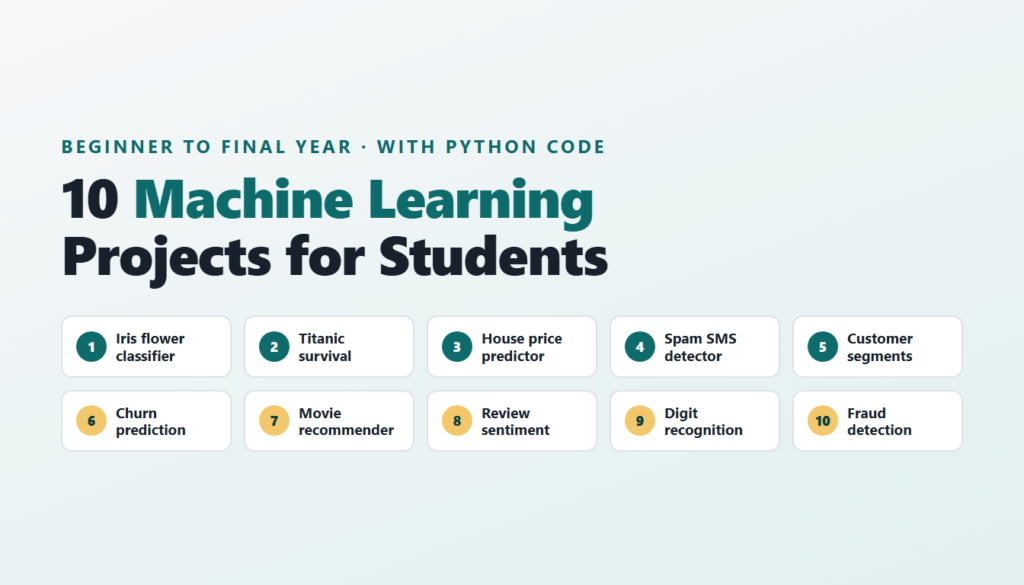
| # | Project | Type | Level | Main library |
|---|---|---|---|---|
| 1 | Iris flower classification | Classification | Beginner | scikit-learn |
| 2 | Titanic survival prediction | Classification | Beginner | Pandas, scikit-learn |
| 3 | House price prediction | Regression | Beginner | scikit-learn |
| 4 | Spam SMS detection | Text classification | Beginner–Intermediate | scikit-learn |
| 5 | Customer segmentation | Clustering | Intermediate | scikit-learn |
| 6 | Customer churn prediction | Classification | Intermediate | scikit-learn, XGBoost |
| 7 | Movie recommendation system | Recommender | Intermediate | Pandas, scikit-learn |
| 8 | Sentiment analysis of reviews | NLP | Intermediate–Advanced | scikit-learn, Hugging Face |
| 9 | Handwritten digit recognition | Deep learning | Advanced | TensorFlow or PyTorch |
| 10 | Credit card fraud detection | Imbalanced classification | Advanced | scikit-learn |
10 machine learning projects with Python
1. Iris flower classification
The “hello world” of machine learning. You train a model to identify the species of an iris flower (setosa, versicolor or virginica) from four measurements of its petals and sepals. The dataset is tiny and clean, so you can focus entirely on the machine learning workflow.
- Dataset: the Iris dataset, 150 flowers, built into scikit-learn.
- Algorithms: KNN, logistic regression, decision tree.
- You will learn: train-test split, fitting a model, predictions, accuracy and the confusion matrix.
from sklearn.datasets import load_iris
from sklearn.model_selection import train_test_split
from sklearn.neighbors import KNeighborsClassifier
from sklearn.metrics import accuracy_score

X, y = load_iris(return_X_y=True)
X_train, X_test, y_train, y_test = train_test_split(X, y, test_size=0.2, random_state=42)

model = KNeighborsClassifier(n_neighbors=5)
model.fit(X_train, y_train)
print("Accuracy:", accuracy_score(y_test, model.predict(X_test)))
Take it further: compare three algorithms, plot the decision boundaries, and explain why some flowers are harder to classify than others.
2. Titanic survival prediction
Predict which passengers survived the Titanic disaster from details such as age, gender, ticket class and fare. Unlike Iris, this data has missing values and text columns, so it teaches the data-cleaning skills that real projects demand.
- Dataset: Kaggle’s “Titanic: Machine Learning from Disaster” competition, with 891 passengers in the training set.
- Algorithms: logistic regression, random forest.
- You will learn: handling missing values, encoding categories, feature engineering (for example extracting titles like “Mr” and “Mrs” from names) and submitting to a Kaggle leaderboard.
Take it further: write a short story-driven analysis of who survived and why, with charts, before building the model. Strong exploratory analysis impresses as much as accuracy.
3. House price prediction
Your first regression project: predict a continuous number, the price of a home, from features such as location, income levels, house age and number of rooms. It teaches you how regression differs from classification and how to measure error properly.
- Dataset: the California Housing dataset (about 20,000 districts), built into scikit-learn; or an Indian city housing dataset from Kaggle for a more local project.
- Algorithms: linear regression, random forest regressor, gradient boosting.
- You will learn: regression metrics (MAE, RMSE, R²), feature scaling, correlation analysis and feature importance.
Take it further: build a simple Streamlit web app where a user enters house details and gets a predicted price, and show which features drove the prediction.
4. Spam SMS detection
Build a classifier that labels text messages as spam or genuine. This is your introduction to natural language processing (NLP): turning words into numbers that a model can learn from.
- Dataset: the SMS Spam Collection from the UCI Machine Learning Repository, with about 5,500 labelled messages.
- Algorithms: Naive Bayes, logistic regression, linear SVM.
- You will learn: text cleaning, TF-IDF vectorisation, pipelines, and precision and recall (and why accuracy alone can mislead).
from sklearn.pipeline import make_pipeline
from sklearn.feature_extraction.text import TfidfVectorizer
from sklearn.naive_bayes import MultinomialNB

spam_model = make_pipeline(TfidfVectorizer(stop_words="english"), MultinomialNB())
spam_model.fit(train_messages, train_labels)

print(spam_model.predict(["Congratulations! You won a free prize, call now"]))
Take it further: collect a small set of real promotional and personal messages (with consent and personal details removed), test your model on them, and discuss where it fails.
5. Customer segmentation
Group shoppers into segments based on their income and spending habits, without any labels. This is unsupervised learning, and it mirrors exactly how marketing teams decide who to target with which offers.
- Dataset: the Mall Customers dataset on Kaggle (200 customers), or the larger Online Retail dataset from UCI for an RFM (recency, frequency, monetary) analysis.
- Algorithms: K-means clustering, hierarchical clustering.
- You will learn: feature scaling, choosing the number of clusters with the elbow method and silhouette score, and turning clusters into business personas.
from sklearn.preprocessing import StandardScaler
from sklearn.cluster import KMeans

features = customers[["annual_income", "spending_score"]]
scaled = StandardScaler().fit_transform(features)

kmeans = KMeans(n_clusters=5, n_init=10, random_state=42)
customers["segment"] = kmeans.fit_predict(scaled)
print(customers.groupby("segment")[["annual_income", "spending_score"]].mean())
Take it further: give each segment a name and a recommended marketing action, and present the results as a dashboard. This makes a great bridge project if you also study data analytics and Power BI.
6. Customer churn prediction
Predict which customers of a telecom company are likely to cancel their subscription, so the business can act before they leave. Churn prediction is one of the most common real-world uses of machine learning in companies, which makes it an excellent resume project.
- Dataset: the Telco Customer Churn dataset on Kaggle, with about 7,000 customers.
- Algorithms: logistic regression, random forest, XGBoost.
- You will learn: working with mixed numeric and categorical data, class imbalance, ROC-AUC, and explaining predictions with feature importance or SHAP values.
Take it further: estimate how much revenue the company could save by targeting the top 10% highest-risk customers. Linking model results to money is exactly how ML is judged in industry.
7. Movie recommendation system
Build a system that recommends movies a user is likely to enjoy, similar to what streaming platforms do. Recommender systems are fun to demo because anyone can try them and judge the results.
- Dataset: MovieLens from GroupLens; the 100K version has 100,000 ratings from about 940 users on about 1,680 movies.
- Approaches: content-based filtering (using genres and descriptions), collaborative filtering (using similar users’ ratings), and cosine similarity.
- You will learn: user-item matrices, similarity measures, the cold-start problem and how to evaluate recommendations.
Take it further: build a hybrid recommender that combines both approaches, and create a web page where users pick three movies they like and receive suggestions.
8. Sentiment analysis of reviews
Classify movie or product reviews as positive or negative. Start with classic machine learning, then compare it with a pre-trained transformer model to see how modern NLP improves results.
- Dataset: the IMDB movie reviews dataset (50,000 reviews), or Amazon and Flipkart product reviews available on Kaggle.
- Algorithms: TF-IDF with logistic regression as a baseline, then a pre-trained transformer from Hugging Face.
- You will learn: text preprocessing, baselines, transfer learning and comparing models fairly on the same test set.
Take it further: analyse reviews of a real product category, chart how sentiment changes over time, and extract the most common complaints. This moves you towards the generative AI and NLP skills that employers increasingly want.
9. Handwritten digit recognition
Train a neural network to recognise handwritten digits from 0 to 9. This is the classic first deep learning project and the best way to understand how convolutional neural networks (CNNs) see images.
- Dataset: MNIST, 70,000 images of handwritten digits, available directly in Keras and torchvision.
- Algorithms: a simple dense neural network, then a CNN.
- You will learn: tensors, layers, activation functions, training loops, epochs, and how to use a GPU in Google Colab.
Take it further: build a drawing canvas in a web app where users write a digit with the mouse and the model predicts it live. Then try Fashion-MNIST, a harder dataset of clothing images, using the same code.
10. Credit card fraud detection
Detect fraudulent credit card transactions in a dataset where fraud is extremely rare. This project teaches one of the most important real-world lessons in machine learning: a model can be 99.8% accurate and still be useless.
- Dataset: the Credit Card Fraud Detection dataset on Kaggle, with 284,807 transactions of which only 492 (about 0.17%) are fraud.
- Algorithms: logistic regression with class weights, random forest, isolation forest for anomaly detection.
- You will learn: class imbalance, resampling techniques such as SMOTE, precision-recall curves and choosing a decision threshold based on business cost.
Take it further: compare several approaches to imbalance, explain the trade-off between catching more fraud and annoying genuine customers, and recommend a threshold. This depth makes it a strong final-year project.
How to choose the right project
- Match your current level. If you have never trained a model, start with projects 1 to 3. Jumping to deep learning too early leads to copying code you do not understand.
- Follow your interest. Like finance? Try churn or fraud. Like content? Try sentiment or recommendations. Interest keeps you going when the model misbehaves.
- Think about your target job. Data analyst roles value projects 2, 5 and 6; machine learning roles value 6, 7 and 10; AI and NLP roles value 8 and 9.
- Prefer depth over number. One project done thoroughly, with clean code, clear analysis and a demo, beats five half-finished notebooks.
Turning a project into a final-year project
Examiners have seen the standard Titanic and Iris projects many times. To turn one of these ideas into a strong final-year or major project, add at least two of the following:
- Your own data: collect or combine data from a local source, such as public data from data.gov.in, a survey or a partner organisation.
- A real user: solve a problem for a real shop, NGO or college department, and report their feedback.
- A deployed application: a working web app built with Streamlit, Flask or FastAPI, not just a notebook.
- A careful comparison: evaluate several models properly, with cross-validation, and explain the results.
- Explainability and ethics: show why the model makes its predictions and discuss bias, privacy and fairness.
How to present your projects on GitHub and your resume
- Write a clear README: the problem, the dataset, your approach, results with numbers, a screenshot or demo link, and how to run the code.
- Keep code clean: meaningful variable names, comments where needed, and a
requirements.txtfile listing the libraries. - Lead with results on your resume: “Built a churn model with 0.85 ROC-AUC and identified the top three churn drivers” is stronger than “Used Python and scikit-learn”. Use your own real numbers.
- Share your work: post a short summary with a chart on LinkedIn. It builds your profile and often starts conversations with recruiters.
- Prepare to explain it: be ready to say why you chose your approach, what went wrong and what you would do differently.
Common mistakes to avoid
- Copying source code without understanding it. Use tutorials for ideas, then write your own version. Interviewers can tell.
- Testing on training data. Always keep a separate test set, or your accuracy will be misleadingly high.
- Relying only on accuracy. For imbalanced problems like spam and fraud, use precision, recall and F1.
- Skipping exploratory analysis. Understand your data with charts and summaries before modelling.
- Leaking data. Fit scalers and encoders on the training data only, then apply them to the test data.
- Never finishing. A finished, documented simple project beats an ambitious one abandoned halfway.
Frequently asked questions
Which machine learning project is best for beginners?
Iris flower classification is the best first project because the data is small and clean. Follow it with Titanic survival prediction and house price prediction to learn data cleaning and regression.
Which machine learning project is good for a final year?
Credit card fraud detection, customer churn prediction, recommendation systems and sentiment analysis make strong final-year projects, especially when you add your own data, a deployed app and a careful model comparison.
Where can I find datasets for machine learning projects?
Good free sources include Kaggle, the UCI Machine Learning Repository, datasets built into scikit-learn, Hugging Face Datasets, and India’s open-data portal, data.gov.in.
How many machine learning projects should I have on my resume?
Three to five well-documented projects that show different skills, such as classification, regression, NLP and deep learning, are usually enough for a fresher resume.
Do I need a powerful laptop for these projects?
No. Projects 1 to 8 run comfortably on an ordinary laptop. For deep learning projects, use Google Colab, which offers limited free GPU access in your browser.
Can I use source code from GitHub for my project?
You can learn from it, but write your own implementation, credit any code you reuse, and follow your college’s rules. Understanding your code matters more than finishing quickly.
How long does a machine learning project take?
A beginner project can take a few days. An intermediate project typically takes one to two weeks, and a polished final-year project with a deployed app can take one to three months.
Conclusion: start your first project this week
The best machine learning project is the one you finish. Start with Iris or Titanic this week, move through the list at your own pace, and document each project as you go. By the time you reach fraud detection or digit recognition, you will have a portfolio that shows real skill and a set of stories ready for any interview or viva.
If you would like guided projects with a mentor, explore Gauri AI’s AI and Machine Learning course, which includes live projects from Python basics to LLM apps, in Jaipur or live online. You can also read our guide on how to become an AI engineer, or talk to a course advisor.
Pingback: Build a RAG Chatbot with Python and LangChain | Gauri AI