
AI engineers are the people who turn models into products. They build the chatbots that answer customers, the assistants that summarise documents, the systems that detect fraud and the agents that complete tasks on their own. If you are wondering how to become an AI engineer by 2027, the good news is that the path is now clearer than ever, and it does not require a PhD. It does require a structured plan, steady practice and a portfolio that proves you can build.
This guide gives you that plan: what an AI engineer actually does, the skills employers expect, an 8-step roadmap with timelines, a 12-month study plan, portfolio projects, salary expectations in India, and the latest numbers on where the job market is heading.
Key takeaways
- An AI engineer builds and deploys AI-powered applications, especially with large language models (LLMs), rather than only researching new algorithms.
- The core stack is Python, machine learning, deep learning, LLM APIs, retrieval-augmented generation (RAG), agents and deployment.
- With focused study, a beginner can become job-ready in about 9 to 12 months; someone who already codes can do it faster.
- Projects matter more than certificates. Aim for four to six well-documented projects on GitHub.
Table of contents
- What does an AI engineer do?
- Why become an AI engineer in 2027: the latest stats
- AI engineer skills required
- The 8-step AI engineer roadmap
- A 12-month study plan
- Portfolio projects that get interviews
- Your path by background: after 12th, graduates and professionals
- AI engineer salary in India
- How to get hired: resume, GitHub and interviews
- Common mistakes to avoid
- Frequently asked questions
What does an AI engineer do?
An AI engineer designs, builds and maintains software that uses artificial intelligence. In 2027 that usually means working with large language models and other pre-trained models: choosing the right model, connecting it to company data, writing the application around it, testing its answers, and running it reliably in production. A typical week might include building a RAG pipeline over internal documents, writing evaluation tests for a chatbot, fine-tuning a small model, and optimising cost and response time.
The role overlaps with machine learning engineering and data science, but the focus is different:
| Role | Main focus | Typical output |
|---|---|---|
| AI Engineer | Building applications with LLMs and pre-trained models | Chatbots, copilots, RAG systems, AI agents, AI features in products |
| Machine Learning Engineer | Training, tuning and serving predictive models | Recommendation, forecasting, classification and ranking systems |
| Data Scientist | Analysing data and building models to answer business questions | Insights, experiments, statistical models, reports |
| MLOps Engineer | Deploying, monitoring and automating model pipelines | CI/CD for models, monitoring dashboards, scalable infrastructure |
In practice, AI engineers borrow skills from all three neighbouring roles. That is why the roadmap below starts with machine learning fundamentals before moving to LLMs and deployment.
Why become an AI engineer in 2027: the latest stats
Demand for AI skills is backed by data, not just hype. Here are figures from widely cited reports:
| Statistic | Source |
|---|---|
| 170 million new jobs are projected to be created globally by 2030 and 92 million displaced, a net gain of 78 million | World Economic Forum, Future of Jobs Report 2025 |
| Technology skills in AI, big data, and networks and cybersecurity are expected to see the fastest growth in demand | World Economic Forum, Future of Jobs Report 2025 |
| 59 out of every 100 workers are projected to need reskilling or upskilling by 2030 | World Economic Forum, Future of Jobs Report 2025 |
| 78% of organisations reported using AI in 2024, up from 55% the year before | Stanford HAI, AI Index Report 2025 |
| Generative AI attracted $33.9 billion in private investment globally in 2024 | Stanford HAI, AI Index Report 2025 |
| India’s AI market is growing at a 25–35% CAGR and is expected to reach about $17 billion by 2027 | Nasscom-BCG report, via IndiaAI |
| India has around 420,000 employees working in AI job functions, the second-largest installed AI talent base | Nasscom-BCG report, via IndiaAI |
Put simply: most organisations now use AI, investment in generative AI is large, and India’s AI market is expected to keep growing quickly through 2027. Companies need engineers who can turn that investment into working systems, and the gap between demand and skilled talent is where your opportunity lies.
AI engineer skills required
Here are the skills that appear most often in AI engineer job descriptions, grouped by what they help you do:
| Skill area | Why it matters | Tools to learn |
|---|---|---|
| Programming | Everything is built in code | Python, Git, basic Linux and command line |
| Data handling | Models are only as good as their data | NumPy, Pandas, SQL |
| Maths for ML | Understand why models behave as they do | Linear algebra, probability, statistics basics |
| Machine learning | Foundation for every AI system | scikit-learn, XGBoost |
| Deep learning | Powers vision, speech and language models | PyTorch or TensorFlow, Hugging Face |
| LLMs and generative AI | The core of most new AI products | LLM APIs, prompt engineering, fine-tuning basics |
| RAG and agents | Connect models to real data and tools | Embeddings, vector databases, LangChain or LlamaIndex, function calling |
| Evaluation and safety | Prove the system works and fails safely | Test sets, LLM evaluation frameworks, guardrails |
| Deployment and MLOps | Get AI into users’ hands reliably | FastAPI, Docker, a cloud platform (AWS, Azure or GCP), monitoring |
| Soft skills | Explain trade-offs and work with teams | Writing, communication, product thinking |
You do not need to master every tool. Learn the concepts deeply and one tool per category well; switching to another framework later is easy.
The 8-step AI engineer roadmap
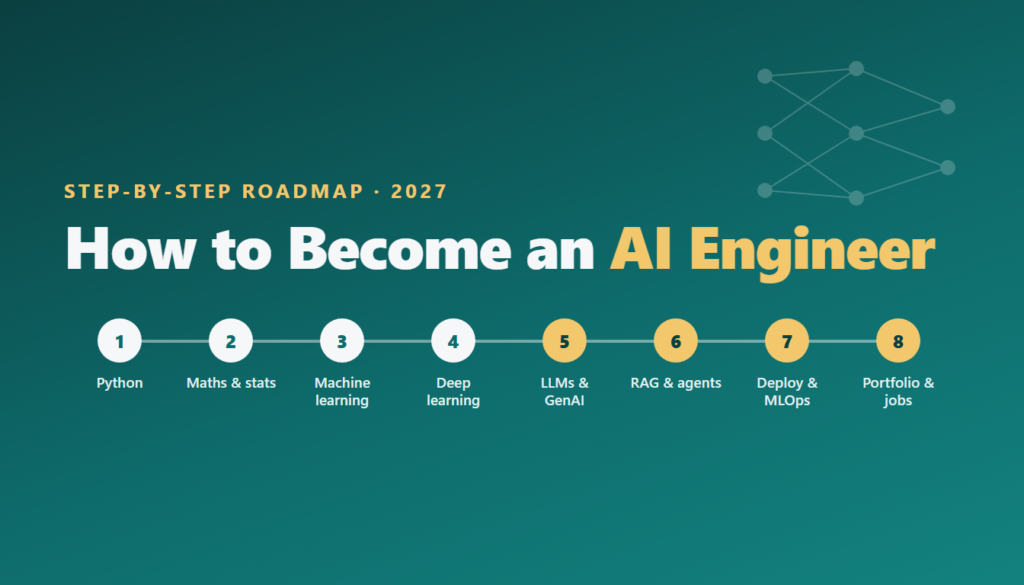
Step 1: Learn Python and programming basics (4–6 weeks)
Python is the language of AI. Learn variables, data types, loops, functions, classes, error handling and working with files and APIs. Then learn Git so you can version your work, and basic command-line skills. Finish by learning NumPy and Pandas for data. Mini project: a script that pulls data from a public API, cleans it with Pandas and saves a summary report. If you are starting from zero, a structured Python programming course will save you weeks.
Step 2: Build your maths and statistics foundation (3–4 weeks)
Focus on intuition, not proofs. Learn vectors, matrices and dot products (how embeddings and neural networks represent data), probability and distributions, mean, variance and correlation, and the idea of gradient descent (how models learn by reducing error). Learn these alongside code so each concept is something you can see and test.
Step 3: Master machine learning fundamentals (6–8 weeks)
Learn supervised and unsupervised learning with scikit-learn: regression, classification, decision trees, ensembles and clustering. More important than algorithms is the workflow: splitting data, feature engineering, cross-validation, choosing metrics and spotting overfitting. Our beginner guides to linear regression, logistic regression and support vector machines are a good place to start. Mini project: a churn or house-price prediction model with a clear write-up of which features matter.
Step 4: Learn deep learning (6–8 weeks)
Learn how neural networks are trained, then build them in PyTorch (the most common choice in AI teams) or TensorFlow. Cover convolutional networks for images, transfer learning with pre-trained models, and the transformer architecture behind every modern language model. Use the Hugging Face ecosystem to load and fine-tune models. Mini project: an image classifier improved with transfer learning, or a text classifier built on a pre-trained transformer.
Step 5: Work with LLMs and generative AI (4–6 weeks)
This is where AI engineering really begins. Learn how LLMs work (tokens, context windows, temperature, why they hallucinate), how to call LLM APIs from Python, and how to write reliable prompts with clear instructions, examples and structured outputs such as JSON. Learn when to use an API model, an open-weight model you host yourself, or a small fine-tuned model, and how to compare them on quality, cost and speed. A focused Generative AI course can speed this stage up.
Step 6: Build RAG systems and AI agents (6–8 weeks)
Most business AI applications need the model to use company data or take actions. Learn embeddings, chunking strategies and vector databases to build retrieval-augmented generation (RAG). Then learn tool use and function calling, and build agents that plan multi-step tasks, call APIs and recover from errors. Just as important: learn to evaluate these systems with test questions, accuracy checks and guardrails, because an AI system you cannot measure is one you cannot ship. Our Agentic AI course covers this stage in depth.
Step 7: Deploy, monitor and scale (4–6 weeks)
Companies hire AI engineers to ship working products. Learn to wrap models in an API with FastAPI, package them with Docker, deploy to a cloud platform, and add logging, monitoring, caching and cost tracking. Learn basic CI/CD so updates are tested automatically. This is the skill that most separates job-ready candidates from tutorial-followers; see our MLOps training if you want guided practice.
Step 8: Build your portfolio and apply (ongoing)
Polish your best four to six projects, write clear README files with screenshots and results, deploy at least two as live demos, and publish short write-ups on LinkedIn or a blog explaining what you built and what you learned. Start applying for internships and junior roles while you finish the last steps; interview practice is part of learning.
A 12-month study plan
If you can study 10 to 15 hours a week, this plan takes a beginner to job-ready in about a year. If you already code, compress months 1 to 3 and move faster.
| Months | Focus | Output by the end |
|---|---|---|
| 1–2 | Python, Git, NumPy, Pandas | Data-cleaning scripts on GitHub |
| 3 | Maths and statistics for ML | Notebooks explaining key concepts with code |
| 4–5 | Machine learning with scikit-learn | Two end-to-end ML projects |
| 6–7 | Deep learning, transformers, Hugging Face | Image or text classifier using transfer learning |
| 8 | LLM APIs, prompt engineering, structured outputs | A small LLM-powered tool |
| 9–10 | RAG, vector databases, agents, evaluation | A document chatbot and a simple agent, both with evaluation |
| 11 | FastAPI, Docker, cloud deployment, monitoring | One project deployed as a live app |
| 12 | Portfolio, resume, interview practice | Polished GitHub, resume and applications sent |
Portfolio projects that get interviews
Recruiters see many copies of the same tutorial projects. Choose projects that solve a real problem, use real data and show the full lifecycle from data to deployment:
- Document Q&A assistant (RAG): answers questions from a set of PDFs, such as college regulations or product manuals, and cites its sources. Include an evaluation set showing accuracy.
- AI agent for a workflow: for example, an agent that reads incoming emails, classifies them and drafts replies or creates tasks, with a human approval step.
- Fine-tuned small model: fine-tune a small open model for a narrow task, such as classifying support tickets, and compare it with a prompted large model on cost and accuracy.
- Classic ML system: a demand forecasting or churn model with a dashboard that explains its predictions.
- Multimodal app: an app that reads images, such as receipts or product photos, and extracts structured data.
- Deployed AI API: any of the above served with FastAPI and Docker on a cloud platform, with logging and a simple usage dashboard.
For each project, write a README that covers the problem, the approach, the results with numbers, the limitations and what you would improve. That write-up often matters as much as the code.
Your path by background: after 12th, graduates and professionals
How to become an AI engineer after 12th
If you are finishing school, a B.Tech in Computer Science or AI and Data Science, or a BCA or B.Sc in Computer Science, gives you a strong base and campus placement opportunities. Students with PCM have the most options for engineering degrees. Do not wait for college to teach you everything: start Python and small projects in your first year, and you will graduate with a portfolio that most of your classmates will not have.
After graduation (B.Tech, BCA, B.Sc, B.Com or BBA)
Graduates from computer science backgrounds can usually start at Step 3. Graduates from commerce, management or other fields should start at Step 1 and plan for the full year. A structured, project-based course such as our AI and Machine Learning course can provide the discipline and mentoring that self-study often lacks. If you live in Rajasthan, our guide to choosing an AI course in Jaipur compares the options.
Working professionals and career switchers
Software developers have the shortest route: your coding, Git and deployment skills transfer directly, so focus on Steps 3 to 6. Data analysts already know data and SQL; add Python ML and then LLM skills. In both cases, look for chances to build an AI feature in your current job. An internal project with real users is the most convincing portfolio item there is.
Can you become an AI engineer without a degree?
Yes, especially at startups and product companies that hire on skills. Some large employers and visa processes still prefer degrees, so without one, your portfolio, open-source contributions and live projects need to be stronger. Freelance AI work for small businesses is a practical way to build that track record.
AI engineer salary in India
Salaries vary widely by company, city, skills and the strength of your portfolio, so treat these ranges as indicative only. They reflect typical offers seen across Indian job listings and salary platforms; check current listings for up-to-date figures in your city.
| Experience | Indicative annual salary | What drives the upper end |
|---|---|---|
| Fresher (0–1 year) | About ₹5 lakh to ₹10 lakh | Strong projects, internships, product-company offers |
| Mid-level (2–5 years) | About ₹10 lakh to ₹25 lakh | LLM, RAG and deployment experience, ownership of production systems |
| Senior (5+ years) | ₹25 lakh and above | System design, leading teams, specialised domains |
Bengaluru, Hyderabad, Pune and Delhi NCR typically pay more than smaller cities, but remote roles increasingly let engineers in cities like Jaipur earn competitive salaries.
How to get hired: resume, GitHub and interviews
- Resume: keep it to one page. Lead with projects and results (“built a RAG assistant that answered 85% of test questions correctly”) rather than a long list of tools.
- GitHub: pin your best projects, each with a clear README, setup steps and a demo link or screenshots.
- LinkedIn: use “AI Engineer” or “Aspiring AI Engineer” in your headline, list your skills, and post short updates about what you build.
- Interview topics: Python coding, ML fundamentals (bias and variance, metrics, overfitting), how transformers and LLMs work, RAG design choices, evaluation methods, and a system-design question such as “design a support chatbot for 10,000 users”.
- Project walkthrough: be ready to explain one project in depth: why you chose your approach, what failed and what you would change.
Common mistakes to avoid
- Tutorial hell: watching courses without building. Aim to spend at least half your time writing code.
- Skipping fundamentals: jumping straight to LLM APIs without understanding ML makes debugging and evaluation very hard.
- Chasing every new tool: frameworks change monthly. Concepts such as retrieval, evaluation and deployment last.
- Never deploying: a notebook is not a product. Ship at least one live app.
- Ignoring evaluation and safety: employers want engineers who can prove a system works and handle its failures responsibly.
- Applying too late: start applying for internships and junior roles before you feel completely ready.
Frequently asked questions
How long does it take to become an AI engineer?
A complete beginner studying 10 to 15 hours a week can become job-ready in about 9 to 12 months. Developers who already code can often do it in 4 to 6 months.
Do I need a degree to become an AI engineer?
A computer science or related degree helps, but many companies hire on skills. Without a degree, a strong portfolio of deployed projects becomes even more important.
Is coding required to become an AI engineer?
Yes. AI engineering is a software role, and Python is essential. The good news is that you can start from zero; Step 1 of the roadmap covers it.
What is the difference between an AI engineer and an ML engineer?
An ML engineer mainly trains and serves predictive models. An AI engineer mainly builds applications on top of LLMs and pre-trained models, including RAG systems and agents. The skills overlap heavily.
Will AI replace AI engineers?
AI tools make engineers faster, but someone still needs to design systems, connect them to data, evaluate them and take responsibility for how they behave. Those skills are becoming more valuable, not less.
Which AI engineer course should I take?
Choose a course that covers Python, ML, deep learning, LLMs, RAG and deployment, and that makes you build real projects. Compare options against the 8 steps in this roadmap.
Conclusion: start your AI engineer journey today
Becoming an AI engineer in 2027 is a realistic goal if you follow a clear roadmap: build strong Python and ML foundations, learn deep learning and LLMs, master RAG, agents and evaluation, learn to deploy, and prove it all with a portfolio of real projects. The demand is there, and the skills you build will stay valuable as the tools change.
If you would like structured guidance, live projects and mentoring, explore Gauri AI’s AI and Machine Learning course, available in our Jaipur classroom and live online, or talk to a course advisor.
Pingback: Build a RAG Chatbot with Python and LangChain | Gauri AI