
Artificial intelligence, machine learning and deep learning are often used as if they mean the same thing. They do not. Understanding AI vs machine learning vs deep learning is the first step to understanding how tools like ChatGPT, Google Maps, Netflix recommendations and face unlock actually work, and it is essential if you are planning a career in technology.
The short version: AI is the broad goal of making machines act intelligently, machine learning is one way of achieving AI by learning from data, and deep learning is a powerful type of machine learning that uses many-layered neural networks. This guide explains each one in plain language, compares them side by side with examples, shows where generative AI fits, and shares the latest numbers on how fast the field is growing.
Key takeaways
- Deep learning is a subset of machine learning, and machine learning is a subset of artificial intelligence.
- Not all AI learns from data: early AI used hand-written rules. Machine learning learns patterns from examples instead.
- Deep learning excels with images, speech and language but needs much more data and computing power.
- Generative AI, including ChatGPT and other large language models, is built on deep learning.
Table of contents
- AI vs ML vs DL in one minute
- What is artificial intelligence?
- What is machine learning?
- What is deep learning?
- Where do generative AI and ChatGPT fit?
- AI vs ML vs DL: comparison table
- Real-world examples side by side
- Latest AI statistics
- When to use machine learning vs deep learning
- Careers and skills in AI, ML and DL
- Which should you learn first?
- Common myths
- Frequently asked questions
AI vs ML vs DL in one minute
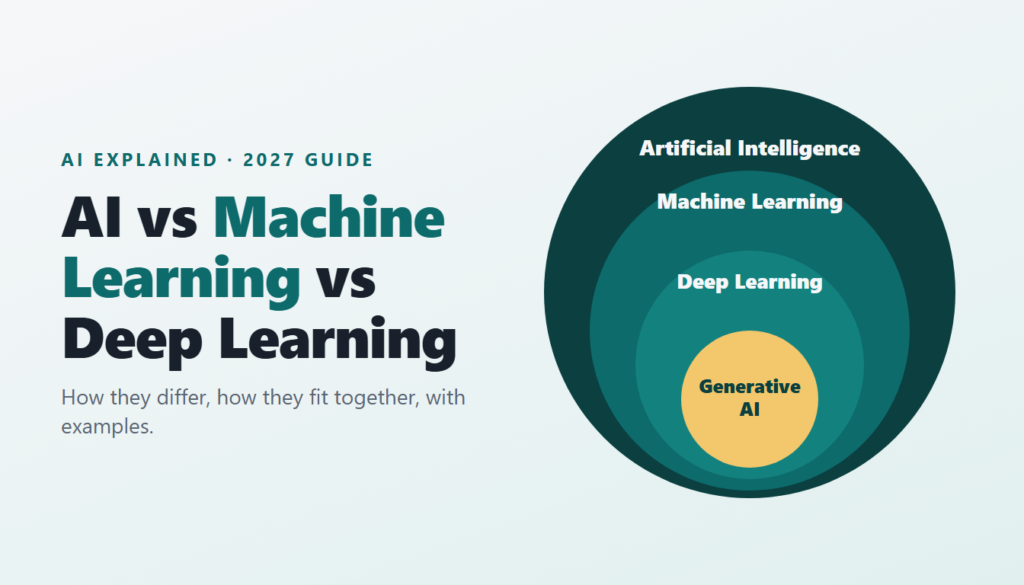
Think of three nested circles. The outer circle is artificial intelligence: any technique that lets a computer perform tasks we associate with human intelligence, such as reasoning, recognising speech or making decisions. Inside it is machine learning: AI systems that learn patterns from data instead of following only hand-written rules. Inside that is deep learning: machine learning that uses neural networks with many layers to learn directly from raw data like pixels, sound and text.
So every deep learning system is a machine learning system, and every machine learning system is an AI system, but the reverse is not true. A chess program built from hand-coded rules is AI but not machine learning. A spam filter trained on labelled emails is machine learning but may not be deep learning. A face-recognition system built on a convolutional neural network is all three.
What is artificial intelligence?
Artificial intelligence is the field of computer science focused on building systems that can perform tasks that normally require human intelligence: understanding language, recognising images, planning, solving problems and making decisions. The term was coined in the 1950s, and for decades most AI was built from rules that experts wrote by hand.
Two broad approaches to AI
- Rule-based (symbolic) AI: people write explicit if-then rules. Examples include early expert systems for medical diagnosis, simple chatbots with scripted replies, and game AI in many video games. These systems are predictable and explainable, but they break when they meet situations their rules did not anticipate.
- Learning-based AI: the system learns its own rules from data. This is machine learning, and it is the approach behind nearly all modern AI.
Narrow AI vs general AI
Every AI system in use today is narrow AI (also called weak AI): it is good at specific tasks, such as translating text, recommending videos or detecting fraud, but it does not have general understanding. Artificial general intelligence (AGI), a system that could learn and reason across any task like a human, remains a research goal, and experts disagree on when or whether it will arrive.
Everyday examples of AI: voice assistants, navigation apps that predict traffic, email spam filters, recommendation feeds, fraud alerts from your bank, and customer support chatbots.
What is machine learning?
Machine learning is a branch of AI in which computers learn patterns from data and improve with experience, without being explicitly programmed for every case. Instead of writing a rule like “if the email contains the word lottery, mark it as spam”, you show the system thousands of emails labelled spam or not spam, and it learns which combinations of features predict spam.
The three main types of machine learning
- Supervised learning: learns from labelled examples to predict a known answer. Used for price prediction (linear regression), yes-or-no decisions such as loan approval (logistic regression), and classification with methods like KNN, SVM and Naive Bayes.
- Unsupervised learning: finds structure in unlabelled data, such as grouping customers into segments (clustering) or spotting unusual transactions (anomaly detection).
- Reinforcement learning: an agent learns by trial and error, receiving rewards for good actions. Used in robotics, game-playing systems and to fine-tune large language models with human feedback.
A key point about classic machine learning is feature engineering: people usually decide which inputs the model should look at. For a house-price model, a data scientist chooses features such as area, number of rooms and location. The model then learns how much each feature matters. Classic ML works very well on structured, tabular data, such as spreadsheets and database tables, and it often needs far less data and computing power than deep learning.
Everyday examples of machine learning: credit scoring, demand forecasting in retail, product recommendations, predicting customer churn, and detecting fraudulent card payments.
What is deep learning?
Deep learning is a type of machine learning that uses artificial neural networks with many layers, which is where the word “deep” comes from. Each layer learns to detect patterns at a different level. In an image model, early layers detect edges, middle layers detect shapes such as eyes or wheels, and later layers recognise whole objects such as faces or cars.
The big advantage of deep learning is that it learns features automatically from raw data. You do not need to tell an image model to look for edges or a speech model to look for particular sounds; it discovers useful patterns by itself. The trade-off is that deep learning usually needs large amounts of data, powerful hardware such as GPUs, and longer training times, and its decisions are harder to explain.
Common deep learning architectures
- Convolutional neural networks (CNNs): for images and video, such as medical scan analysis and face unlock.
- Recurrent neural networks (RNNs) and LSTMs: earlier models for sequences such as text and time series, now largely replaced by transformers for language.
- Transformers: the architecture behind large language models, modern translation and many image and speech models.
- Diffusion models: used by image generators that create pictures from text prompts.
Everyday examples of deep learning: face unlock on your phone, voice typing, real-time translation, self-driving perception systems, medical image analysis and AI chat assistants.
Where do generative AI and ChatGPT fit?
Generative AI is AI that creates new content: text, images, code, audio or video. Almost all modern generative AI is built on deep learning, especially transformers and diffusion models. That puts generative AI in the innermost circle of the diagram above.
A large language model (LLM), such as the models behind ChatGPT, Claude or Gemini, is a deep learning model trained on huge amounts of text to predict the next word. So is ChatGPT AI or machine learning? It is both: it is an AI application, built with machine learning, using deep learning, specifically a transformer-based LLM. It is then refined with reinforcement learning from human feedback to make its answers more helpful.
Not all AI is generative, though. A fraud-detection model that outputs “fraud” or “not fraud” is discriminative or predictive AI; it classifies rather than creates. Many businesses get more value from predictive models than from generative ones, which is why both remain in high demand. If generative AI is your main interest, our Generative AI course covers LLMs, prompt engineering and RAG.
AI vs ML vs DL: comparison table
| Aspect | Artificial intelligence | Machine learning | Deep learning |
|---|---|---|---|
| Definition | Machines performing tasks that need human-like intelligence | Systems that learn patterns from data | ML using many-layered neural networks |
| Scope | Broadest field | Subset of AI | Subset of ML |
| How it works | Rules, search, logic or learning | Algorithms learn from features chosen by people | Networks learn features automatically from raw data |
| Data needed | Varies; rule-based AI needs little | Small to medium datasets work well | Usually large datasets |
| Hardware | Varies | Standard CPUs are often enough | GPUs or specialised chips for training |
| Training time | Varies | Seconds to hours | Hours to weeks |
| Best for | Any intelligent behaviour | Structured, tabular data | Images, audio, text and other unstructured data |
| Explainability | Rule-based AI is very explainable | Often fairly explainable | Hard to explain (a “black box”) |
| Example algorithms | Expert systems, search, planning | Linear regression, decision trees, random forests, SVM | CNNs, transformers, diffusion models |
| Example uses | Chess engines, route planning, chatbots | Credit scoring, churn prediction, recommendations | Face unlock, voice assistants, ChatGPT |
Real-world examples side by side
The same problem can often be solved at different levels. Here is how each approach might handle common tasks:
| Task | Rule-based AI | Machine learning | Deep learning |
|---|---|---|---|
| Spam filtering | Block emails with listed words | Learn spam patterns from labelled emails | Understand the meaning of the whole message |
| Loan approval | Fixed income and credit-score thresholds | Predict default risk from past loan data | Rarely needed; classic ML is usually better and easier to explain |
| Customer support | Scripted menu-based chatbot | Classify tickets and route them | LLM chatbot that understands free-text questions |
| Medical imaging | Not practical | Limited, needs hand-crafted features | CNNs that detect patterns in scans |
| Sales forecasting | Last year’s sales plus a fixed percentage | Models using seasonality, prices and promotions | Useful for very large, complex datasets |
Notice that deep learning is not always the best answer. For structured business data, classic machine learning is often faster, cheaper and easier to explain, which matters in regulated areas such as lending and insurance.
Latest AI statistics
These figures show how quickly AI, machine learning and deep learning are moving from research into everyday life and business:
| Statistic | Source |
|---|---|
| 78% of organisations reported using AI in 2024, up from 55% the year before | Stanford HAI, AI Index Report 2025 |
| Generative AI attracted $33.9 billion in private investment globally in 2024, an 18.7% increase from 2023 | Stanford HAI, AI Index Report 2025 |
| Nearly 90% of notable AI models in 2024 came from industry, up from 60% in 2023 | Stanford HAI, AI Index Report 2025 |
| The cost of running a model performing at GPT-3.5 level dropped over 280-fold between November 2022 and October 2024 | Stanford HAI, AI Index Report 2025 |
| The US FDA approved 223 AI-enabled medical devices in 2023, up from six in 2015 | Stanford HAI, AI Index Report 2025 |
| Waymo provides over 150,000 autonomous rides each week | Stanford HAI, AI Index Report 2025 |
| Technology skills in AI and big data are expected to see the fastest growth in demand by 2030 | World Economic Forum, Future of Jobs Report 2025 |
| India’s AI market is growing at 25–35% a year and is expected to reach about $17 billion by 2027 | Nasscom-BCG report, via IndiaAI |
Two trends stand out. First, AI is now mainstream in business, not experimental. Second, AI is getting dramatically cheaper to run, which means deep learning models that were once only affordable for big tech companies are now within reach of startups, small businesses and students.
When to use machine learning vs deep learning
If you are building a solution, use this quick checklist to decide between classic machine learning and deep learning:
| Choose classic machine learning when… | Choose deep learning when… |
|---|---|
| Your data is structured: rows and columns | Your data is unstructured: images, audio, video or free text |
| You have hundreds to tens of thousands of examples | You have very large datasets, or can use a pre-trained model |
| You need to explain each decision | Accuracy matters more than explainability |
| You have limited computing budget | You have GPU access or can use a cloud API |
| You need a working model quickly | You can invest time in training and tuning |
A practical tip: today you rarely need to train a deep learning model from scratch. Pre-trained models and APIs let you apply deep learning with small datasets through transfer learning or simple prompting, which has made deep learning far more accessible.
Careers and skills in AI, ML and DL
Because the three fields overlap, the career paths do too. Here are common roles and where they sit:
| Role | Main focus | Key skills |
|---|---|---|
| Data Analyst | Reports, dashboards, basic predictive models | Excel, SQL, Power BI, Python basics |
| Data Scientist | Analysis and machine learning models for business questions | Statistics, Python, scikit-learn |
| Machine Learning Engineer | Building and deploying ML models in production | Python, ML, MLOps, cloud |
| Deep Learning or Computer Vision Engineer | Neural networks for images, video and audio | PyTorch or TensorFlow, CNNs, GPUs |
| NLP Engineer | Language models, text classification, search | Transformers, embeddings, Hugging Face |
| AI Engineer | Building products with LLMs, RAG and agents | LLM APIs, RAG, evaluation, deployment |
If building AI products is your goal, read our step-by-step guide on how to become an AI engineer. If you prefer analysis and business insight, start with our Data Analytics course or Data Science course.
Which should you learn first?
Learn them in the same order they nest, from the outside in, but with a practical twist: start with the tools, not the theory.
- Python and data basics: Python, NumPy and Pandas. A Python programming course is the quickest start if you are new to coding.
- Core AI concepts and statistics: what AI can and cannot do, probability, and basic statistics.
- Machine learning: supervised and unsupervised learning with scikit-learn on real datasets.
- Deep learning: neural networks, CNNs and transformers with PyTorch or TensorFlow.
- Generative AI: LLMs, prompt engineering, RAG and AI agents.
Skipping straight to deep learning or generative AI without machine learning foundations is tempting, but it makes it much harder to understand why models fail and how to fix them. Our AI and Machine Learning course follows this exact order over six months, in our Jaipur classroom or live online. If you are in Rajasthan, our guide to choosing an AI course in Jaipur may also help.
Common myths about AI, ML and deep learning
- “AI and machine learning are the same thing.” Machine learning is one approach to AI. Rule-based systems are AI without machine learning.
- “Deep learning is always better.” For structured data and small datasets, classic ML often wins on accuracy, speed, cost and explainability.
- “You need a PhD to work in AI.” Research roles may need one, but most industry roles in ML and AI engineering hire on skills and projects.
- “AI understands like a human.” Today’s AI recognises patterns very well but does not have human understanding or common sense, which is why it can make confident mistakes.
- “AI will replace everyone.” AI automates tasks, not whole jobs, in most cases. People who know how to work with AI are better placed than those who do not; see our article on whether AI will replace data analysts.
Frequently asked questions
What is the main difference between AI, ML and deep learning?
AI is the broad goal of making machines intelligent. Machine learning is a way to achieve AI by learning from data. Deep learning is a type of machine learning that uses many-layered neural networks and learns features automatically from raw data.
Is deep learning part of machine learning?
Yes. Deep learning is a subset of machine learning, and machine learning is a subset of artificial intelligence.
Is ChatGPT AI, machine learning or deep learning?
All three. ChatGPT is an AI application built on a large language model, which is a deep learning model trained with machine learning techniques, including reinforcement learning from human feedback.
What is the difference between AI and ML with an example?
A traffic-light controller that changes lights on a fixed rule-based schedule is simple AI without learning. A system that learns from months of traffic data to predict congestion and adjust timings is machine learning.
Which is better: machine learning or deep learning?
Neither is better in general. Machine learning is usually better for structured data, small datasets and decisions that must be explained. Deep learning is better for images, speech and language, and for very large datasets.
Is generative AI the same as deep learning?
No, but it is built on deep learning. Generative AI is the use of deep learning models, such as transformers and diffusion models, to create new text, images, audio or code.
Should I learn machine learning before deep learning?
Yes. Machine learning teaches core ideas such as training, testing, overfitting and evaluation metrics, which you need to understand and debug deep learning models.
Conclusion
Artificial intelligence, machine learning and deep learning are not competitors; they are layers of the same field. AI is the goal, machine learning is the main method for reaching it today, and deep learning is the most powerful form of machine learning for complex data such as images and language. Generative AI, including tools like ChatGPT, sits at the centre, built on deep learning.
With organisations adopting AI faster than ever, understanding these differences is the foundation for any career in technology. When you are ready to go from understanding to building, explore Gauri AI’s AI and Machine Learning course or talk to a course advisor.
Pingback: Build a RAG Chatbot with Python and LangChain | Gauri AI
Pingback: What Is Agentic AI? Examples, Tools & Projects | Gauri AI